

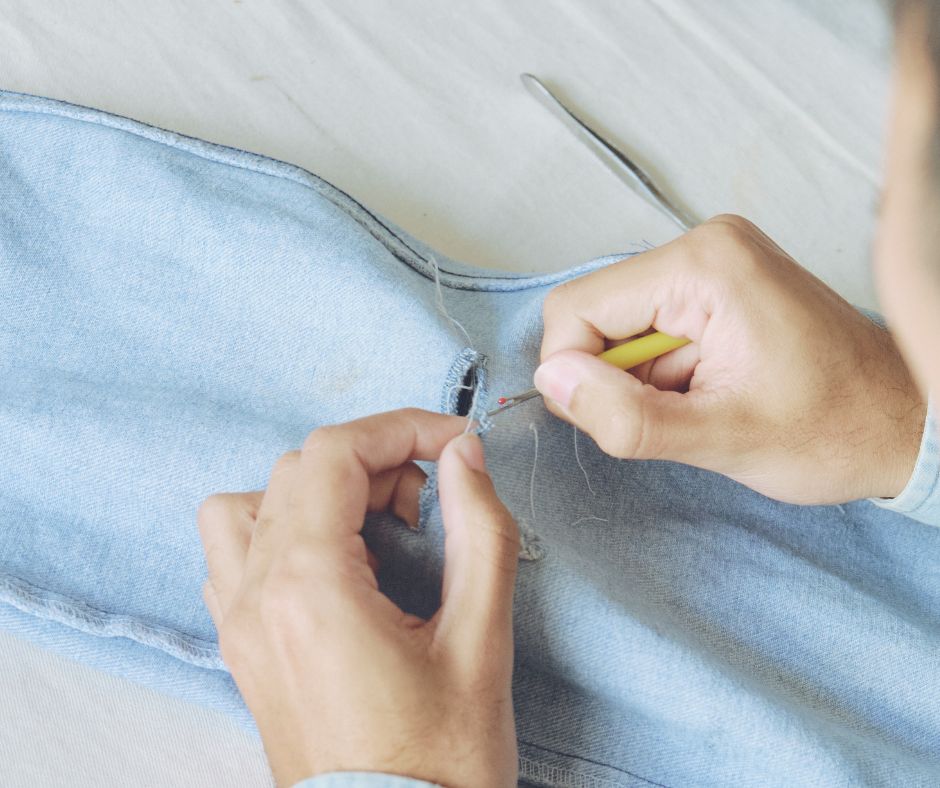
Repair economy: Does fast fashion want to teach us how to sew?
From mending to sewing education workshops: repair is moving beyond the slow fashion niche and into the mainstream. Is this the beginning of a more circular fashion trend or just another service added to a model based on continuous production?
 From niche practice to mainstream service: Levi’s, Uniqlo, Zara, and Primark are teaching consumers how to repair, mend, and care for their clothes. Can repair change the fashion economy? In recent years, mending, tailoring, visible mending, and clothing care have moved beyond slow fashion circles and into major brand stores.
An Associated Press investigation (From Uniqlo to Zara, clothing brands try to win over Gen Z with a needle and thread) explores how Levi’s, Uniqlo, Zara, Primark, and other major fashion brands are investing in repair services, sewing workshops, and programs to extend the life of garments, particularly targeting a younger generation that is both cost-conscious and sustainable.
Repair is becoming a commercial service.
And some brands are trying to turn it into a consumer skill.
From fashion to buy to fashion to keep.
For decades, the relationship between consumers and the fashion industry has been linear: the brand produces, the consumer buys, and when the item is no longer desired or usable, they throw it away and replace it with a new one.
The repair logic, however, introduces a completely different approach: you can modify, repair, customize, and mend what you already own, thus avoiding buying something new and extending its useful life.
It’s not new: Patagonia already did it
Before repair became a strategy for major retailers, some had already made it central to their brand culture. Patagonia, with its Worn Wear program, has been promoting repair, reuse, and maintenance of garments for years, encouraging customers to keep their clothes in use for as long as possible.
The news is different: repair is moving beyond the niche of brands pioneering sustainability and slow fashion to enter the fashion mainstream.
Levi’s: repairing becomes education
One of the most interesting cases is that of Levi’s, which with the Wear Longer Project not only offers repair services but also brings sewing education to schools and communities.
The project stems from an interesting fact: according to research commissioned by Levi Strauss & Co., 41% of Gen Z lacks clothing repair or customization skills, compared to less than 25% of older generations. At the same time, 35% of young people interviewed said that knowing these techniques would help them keep their clothes longer.
This data should obviously be interpreted with caution, as it is research commissioned by the brand. However, the behavior Levi’s observes leads us to reflect on whether, instead of asking ourselves “Which sustainable item should I buy?” we should shift the question to “Do I know how to take care of what I have?”
 Primark teaches mending
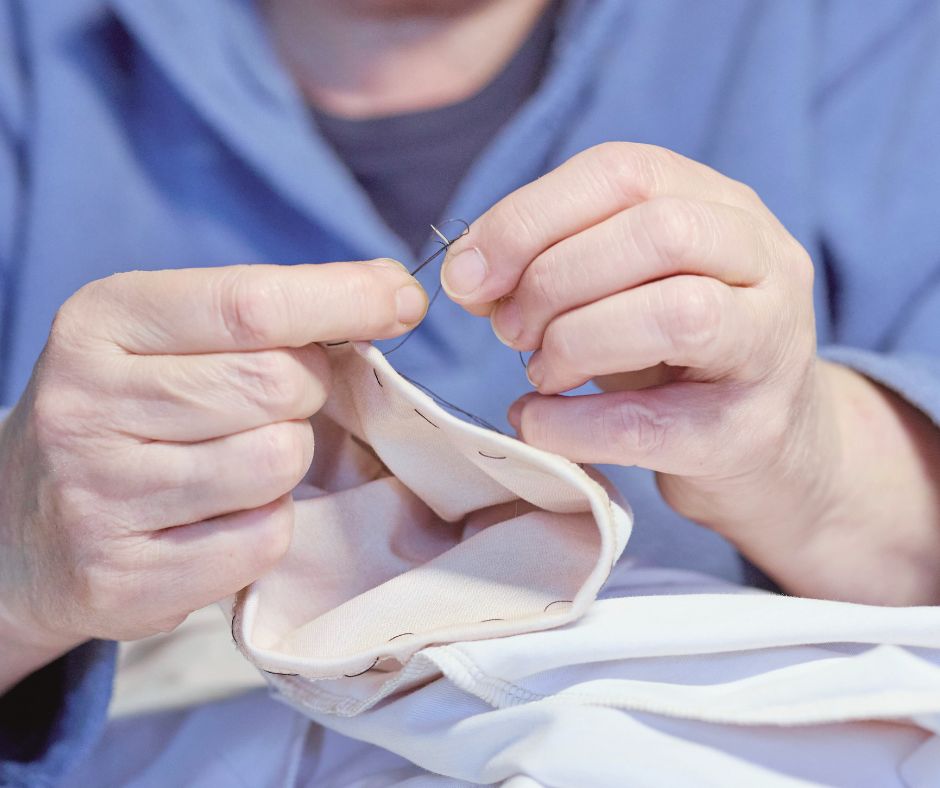
Primark has also transformed repair into an experiential activity with its Love It For Longer workshops, dedicated to mending techniques and basic sewing skills. The retailer claims to have introduced these workshops precisely to help people keep their garments longer.
Considering the brand’s business model, it’s almost a paradox. Is one of the symbols of low-cost, high-volume fashion teaching its customers not to throw away?
This paradox deserves attention: repair is entering mainstream culture not necessarily because the industry has quickly stopped producing, but because it has understood that product care can become a new way of relating to the customer.
Uniqlo: repair, remake, customization
Perhaps the most advanced example is that of Uniqlo, which has built a true ecosystem of services around RE.UNIQLO: Repair, Remake, Reuse, and Recycle. At the RE.UNIQLO Studios, customers can repair holes and tears, alter trousers, add patches, customize garments with embroidery, and use techniques inspired by sashiko, the traditional Japanese practice of decorative mending. Some repairs start at just €3, while sashiko customizations can cost up to €10–20 depending on the service.
Here, repair is presented from a different perspective: it’s not just maintenance, but personalization, through embroidery, mending, or a fabric insert.
And this is precisely what could make repair culturally more desirable for new generations: not a gesture imposed by economic necessity, but a form of personal expression.
Zara also enters the Repair Economy
Zara has also made a repair service available within Zara Pre-Owned. In Italy, it can also be requested through Zara.com: the customer selects the item and the type of repair, delivers the item, and collects it once the repair is complete.
When a repair service arrives within a large retailer, the social perception of the practice also changes. It’s no longer just a necessity for those who can’t afford to buy new items. It becomes a socially accepted gesture, eliminating the fear of appearing insecure about buying fashion.
 Is repairing a business?
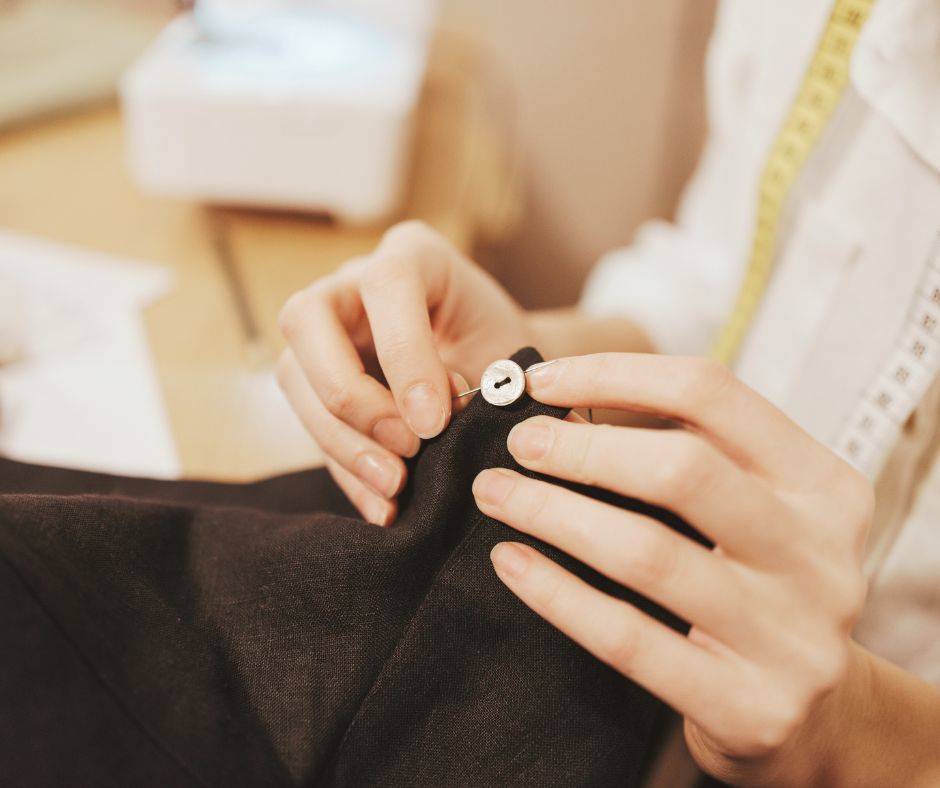
Why would a company invest in an activity that, at least apparently, risks reducing the sale of a new product?
The answer is that repairs can generate additional economic value:
- It can create a new source of revenue.
- It can increase loyalty.
- It can bring customers back to the store by creating an additional point of contact.
- It can provide better insight into how products are used.
- It can generate customization and premium services.
- And above all, it can change the relationship between company and consumer: from a relationship based on a single purchase to one that continues after the purchase.
This is exactly the type of transformation the Ellen MacArthur Foundation is exploring through Fashion ReModel, an initiative involving brands and retailers interested in increasing the share of revenue coming from circular models such as resale, rental, repair, and remaking. The project’s initial findings are interesting: participants’ circular activities are growing faster than the rest of their businesses.
The Foundation itself emphasizes that the real challenge is growing revenue without having to proportionally increase the quantity of new clothing produced. The repair economy has a structural problem. Repairing a garment doesn’t automatically make the system circular. If a brand sells millions of new garments each year and simultaneously offers a repair service to a small portion of its customers, the overall effect could be marginal.
This is precisely the limitation highlighted in the Associated Press investigation: repairs can complement the ongoing production of new clothing without replacing it. Furthermore, repairs are labor-intensive, making them difficult to make economically competitive compared to the production of a new, low-cost garment.
The European Environment Agency itself identifies this very obstacle: high labor costs and the very low price of new products often make repairs commercially uncompetitive. For a consumer, it may be cheaper to buy a new T-shirt than to repair an old one.
Another aspect not to be underestimated is consumer perception of repair brands. According to the study Leveraging repair services as systemic interventions in sustainable fashion (Ahsan, Van Rooy & Du Bois, University of Antwerp, 2026) published in the Proceedings of the Design Society by Cambridge University Press, consumers tend to place greater trust in local repairers than in branded repair services. The authors emphasize, however, that this perception is also linked to consumers’ experiences, knowledge, and values and does not necessarily demonstrate an objective difference in service quality. In another study (Das et al., 2025), consumers expressed a preference for local repair services over those offered by brands, especially with regard to perceived quality, durability, and the absence of functional defects after repair. Local services build trust through personal relationships and the visibility of repair skills and tools. With branded services, however, consumers may have less direct interaction with those who physically perform the repair. The authors also hypothesize that consumers may perceive a discrepancy between the skills of sales staff and those required to repair a garment, thus perceiving the repair carried out by the person selling the garment as less reliable.
 Repair data is promising
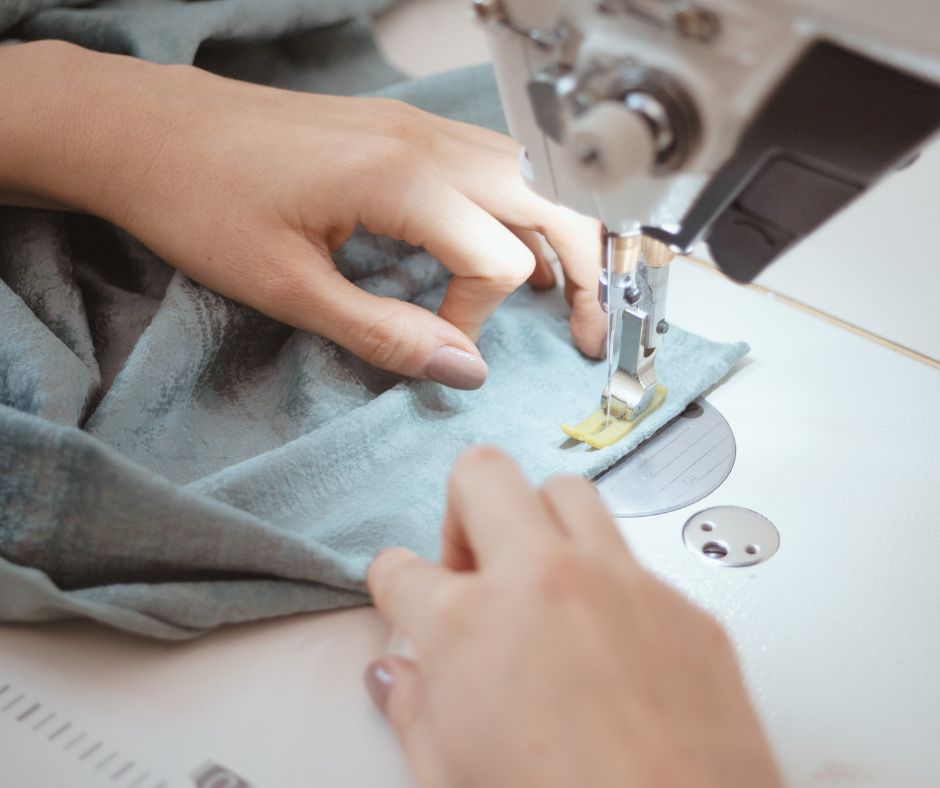
Repair is not a pointless practice. According to the European Environment Agency, in 2025, 95% of textile products brought to monitored European Repair Cafés were successfully repaired. 3,000 out of 3,157 items were repaired in 168 Repair Cafés spread across eight European countries.
And there’s another important statistic: in 2025, 8% of repairs were classified as rather difficult, compared to 4% in 2017. This means that the issue isn’t just about the availability of services.
It’s also about how clothes are designed. A garment that’s easy to repair is different from one designed to simply be replaced.
Easily replaceable buttons, sturdy stitching, durable fabrics, replaceable components, fabric allowances, and design for disassembly: true repairability begins much earlier, in the design phase. Are garment repairs taught in fashion schools? The integration of repair into fashion curricula, primarily at the design stage, has been identified as a crucial intervention point within the broader transition towards circular fashion (Ahsan, Van Rooy & Du Bois, University of Antwerp, 2026).
A skill in sustainable fashion
Sigaard and Laitala (Repairability of clothing and textiles: Consumer practices and policy implications, International Journal of Sustainable Fashion & Textiles, 2025) emphasize the need to go beyond product design and service delivery to also support social learning, cultural normalization, and the integration of repair into everyday life, recognizing its social and cultural significance.
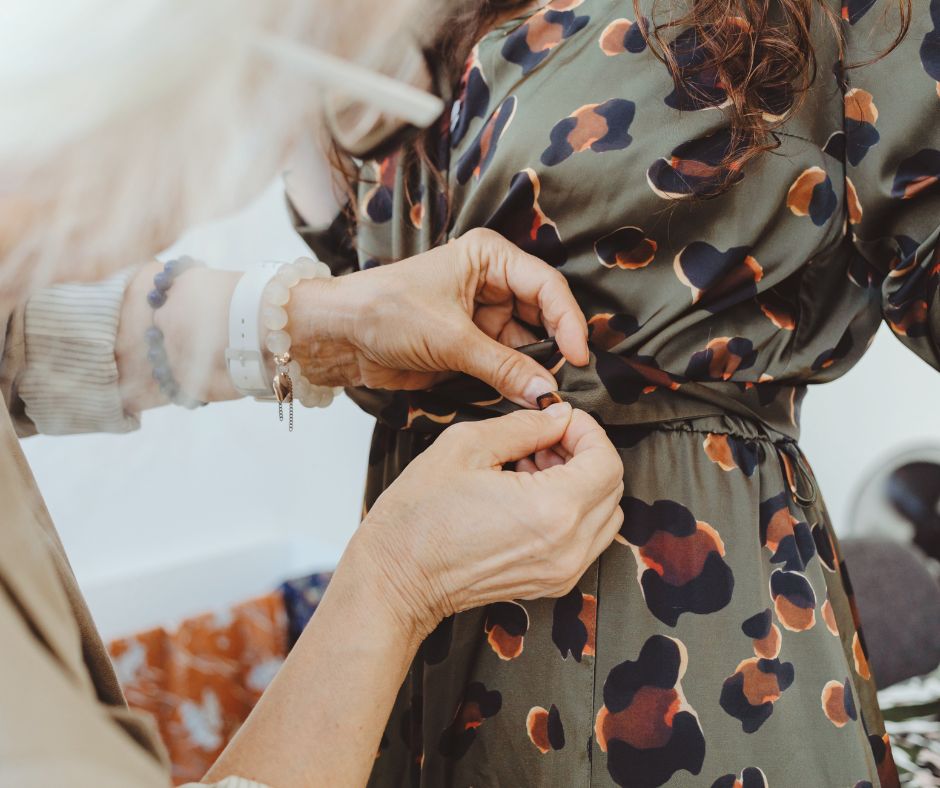
Workshops could be the most interesting part of the new repair economy. If a company repairs your jeans, they’re back in your closet. If, on the other hand, they teach you how to repair them, you can potentially intervene on the next pair, and the one after that. Acquiring a new skill can therefore change behavior.
Not only that. Possessing repair skills is linked to higher self-esteem and a stronger sense of belonging. When people repair objects themselves, they often experience a sense of personal satisfaction, while also developing a deeper connection and greater responsibility towards the repaired object (Ahsan, Van Rooy & Du Bois, University of Antwerp, 2026).
Sustainability in fashion is often communicated through the product: recycled fibers, innovative materials, sustainable capsules, certifications. Repair, on the other hand, introduces the perspective of sustainability as a skill: sewing on a button, mending a small tear, washing a fabric correctly, knowing when it doesn’t need to be washed, altering a garment, recognizing when a defect can become part of a garment’s history. A form of fashion literacy.
From “sustainable fashion” to the “care economy”
This development comes at a particularly significant time from a regulatory perspective. From July 19, 2026, large companies in the European Union can no longer destroy unsold clothing and footwear, as part of the new Ecodesign for Sustainable Products Regulation. Companies must prioritize sales and preparation for reuse. The European Textile Strategy also explicitly aims to make products durable, repairable, and recyclable, and to ensure that reuse and repair services are widely available.
The numbers explain why. In the EU, approximately 19 kg of clothing, footwear, and household textiles are consumed per person per year, while approximately 16 kg of textile waste is generated per capita. Only 15% of household textile waste is collected separately. In other words: before even asking ourselves how to recycle clothes better, we should ask ourselves how to make them last longer.
 Reflections
To understand whether the repair economy is truly impacting the sustainability of fashion, we need to ask what happens next. How many repairs actually prevent a new purchase? How many garments remain in use longer? And above all: do repairs replace sales or simply add to a model that continues to produce and sell more and more new garments?
One of the most interesting findings comes from the United Kingdom. According to WRAP’s Displacement Rates Untangled research, published in 2025, for every five items repaired, four replace the purchase of a new item: a displacement rate of 82.2%. In the same analysis, WRAP estimates that repairing a cotton T-shirt instead of buying a new one can avoid over 7.5 kg of CO₂e.
Counting repairs isn’t enough. It’s no longer just a question of how many brands offer a repair service, but whether that service can change purchasing behavior.
Does fast fashion want to teach us to buy less?
Can an industry built on volume growth become part of the solution, teaching us how to make what we already have last longer?
Today, some of the large retailers who have contributed to the “buy more, wear less” culture are bringing sewing, mending, and repair back into stores. This phenomenon is particularly interesting because the repair literature has associated the growth of fast fashion with the loss of everyday skills that were once taught through school and homework.
The future will depend on what happens to repair when it emerges from the halo effect phase and becomes a true business model. If repair simply means adding a service alongside the sale of new garments, the system changes little. If, on the other hand, it means designing more durable and repairable products, transferring skills, making garment care cost-effective, and—most importantly—replacing a portion of new sales with revenue generated from the care, reuse, and continued use of products, then new prospects open up.

Potrebbero piacerti anche

Designer, questo è per voi!

Stop the microplastics: the appeal of Ecobiocontrol to ECHA (European chemical agency) to protect us and the environment
