

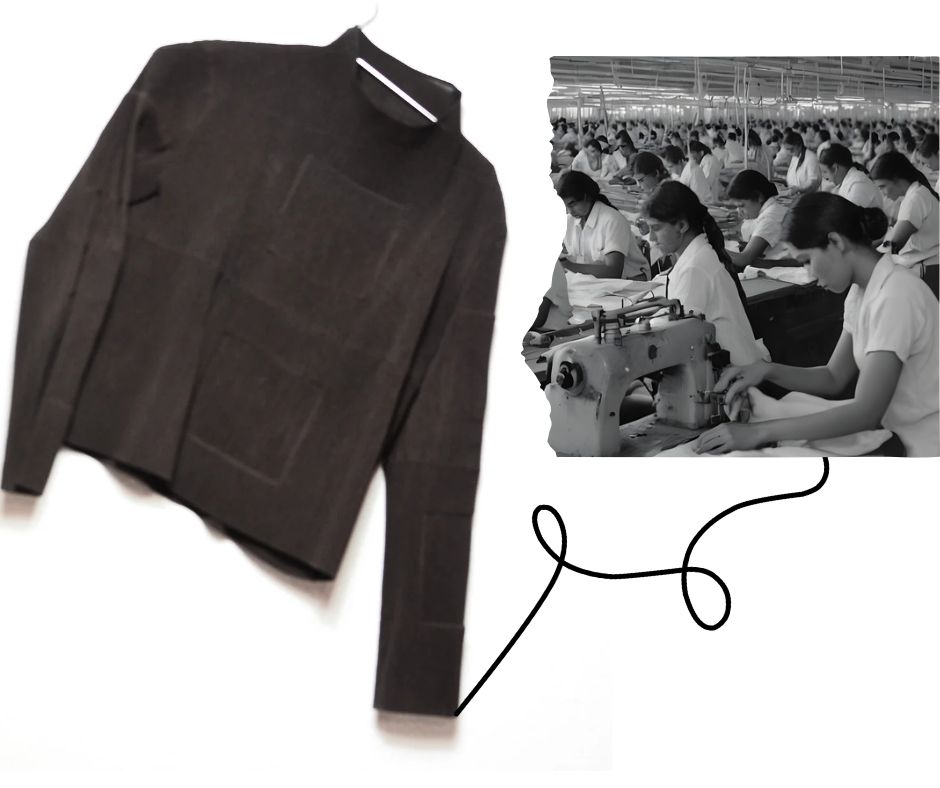
Temu scores zero out of 100: the Ethical Fashion Report analyzes the fashion industry
 From supply chain transparency to the marketplace model—and considering the comparison with Shein—the success of the Chinese platform highlights an issue that concerns the entire fashion industry.
Zero out of 100. This is the score received by Temu in the 2026 edition of the Ethical Fashion Report—a biennial study by Baptist World Aid Australia that analyzes the policies and practices of major fashion companies regarding human rights and environmental sustainability. Behind this score lies an issue that goes beyond the low price of the clothing: the ability to know who makes what we buy, under what conditions, and under whose responsibility.
Temu’s position in the ranking might seem predictable, given the business model of the Chinese platform—which has gained popularity for its extremely low prices and vast product range. Yet, behind that zero lies a more compelling question: how much can we truly know about the conditions under which the products we purchase are made, when the supply chain is opaque and the available information makes it impossible to verify their sustainability?
Temu: a marketplace, not a traditional fashion company
To understand the outcome, one must begin with a specific feature of the Temu model. Launched in Boston in September 2022, Temu belongs to PDD Holdings, a multinational e-commerce group that also operates Pinduoduo—a platform widely used in China.
Temu is a marketplace that connects consumers with merchants, manufacturers, and brands. Sellers list their products on the platform, while Temu provides the services and infrastructure needed to reach consumers. The group also states that the majority of merchants on its platforms are based in China.
In May 2026, the European Commission imposed a €200 million fine on Temu for violations of the Digital Services Act, specifically regarding its failure to adequately assess systemic risks related to the presence of illegal products on the platform. An investigation involving test purchases revealed, among other things, non-compliant children’s toys and electronic goods. On October 26, 2026, the Commission accepted a plan of corrective measures submitted by Temu, which must now be implemented and subjected to independent verification.
To understand the platform’s impact, one must look at a network of operators and suppliers, rather than just an individual manufacturer. When products originate from a complex web of sellers, manufacturers, and suppliers, tracing their origins and verifying working conditions becomes a challenging task. It is not enough to simply know the name of the seller displayed on a product page; one must also be able to identify the entities that produced the materials, manufactured the garments, or carried out various stages of production. The core issue, therefore, lies in the extent to which it is possible to reconstruct what happens prior to the point of sale.
The result for 2026 is not entirely new.
Temu also received a score of zero in the 2024 Ethical Fashion Report. Two years later, that score remains unchanged. This is significant, as the report is published biennially precisely to allow companies to improve their management systems and demonstrate the progress they have made.
It is important to note, however, that this score does not constitute a judicial investigation or a direct audit of working conditions in every factory. It does not automatically prove the existence of forced labor, illegal wages, or human rights violations. Rather, it indicates that the available evidence does not meet the requirements necessary to earn points.
While this is an important distinction, it does not render the result irrelevant. In an industry where supply chains can span numerous countries, facilities, and intermediaries, transparency is an essential prerequisite for exercising genuine accountability.
A company may claim to respect workers’ rights, but how can we verify such a claim if we do not know who the suppliers are, what oversight is in place, or what outcomes have been achieved? Without reliable information regarding who is manufacturing the goods, where they are being produced, what checks are conducted, and what conditions are guaranteed to the workers, it becomes impossible to verify a company’s ethical commitments.
How does the Ethical Fashion Report work?
First published in 2013, following the collapse of the Rana Plaza building in Bangladesh, the Ethical Fashion Report has become a key tool for monitoring the social and environmental practices of fashion companies. The research is conducted every two years, allowing companies time to implement improvements.
The 2026 edition is the eleventh and most comprehensive to date, covering 138 companies that represent over 500 brands. The selection focuses primarily on companies with annual revenues exceeding 50 million Australian dollars that are also relevant to Australian consumers.
The assessment is based on 48 questions, organized into 18 indicators across five core areas:
- Policies and governance: The existence of corporate policies and structures to manage social and environmental impacts.
- Traceability and risk: The ability to identify suppliers and detect risks throughout the supply chain.
- Supplier relationships and human rights monitoring: The quality of business relationships, as well as oversight and the prevention of rights violations.
- Worker empowerment: The extent to which workers are able to understand and assert their rights, report issues, and participate in decision-making processes.
- Environmental sustainability: The management of environmental impacts resulting from production and the supply chain.
For each company, 107 pieces of evidence are analyzed, amounting to over 15,000 data points analysed in the 2026 edition. Not all aspects carry the same weight. The section dedicated to supplier relations and human rights monitoring accounts for 33% of the overall score; worker empowerment for 25%; environmental sustainability for 21%; traceability and risk for 15%; and policies and governance for 6%.
The research also considers three tiers of the supply chain: raw material production, the production of inputs (such as fabrics and components), and final manufacturing. The latter carries the most weight, accounting for 45% of the assessment regarding the distribution across production tiers.
Another important aspect concerns the sources: the research team utilizes information published on company websites, corporate reports, and modern slavery statements, as well as documentation provided directly by the companies. While companies may choose to participate actively by submitting additional evidence, they are not required to do so. In 2026, 42% of the companies participated in the process by providing supplementary information; the others were evaluated based on publicly available data.
It should be noted, however, that the report does not involve direct factory inspections. Consequently, it does not measure the actual conditions within any specific facility; rather, it evaluates the robustness of the corporate systems designed to prevent and address labor rights violations and environmental harm. The score therefore measures a company’s demonstrated capacity to manage these impacts—it does not certify that every individual product is ethical or sustainable.
A company that achieves a high score demonstrates that it has more structured and well-documented systems in place. This does not necessarily mean that problems do not occur within its supply chain. Likewise, a result of zero does not constitute proof that every product is the outcome of illegal practices; rather, it indicates an absence of evidence as defined by the methodology.
Shein 28, Temu zero: a difference that needs to be interpreted
A particularly interesting comparison can be made with Shein, another major player in the ultra-fast fashion sector. In the 2026 edition, Shein scores 28 out of 100 points, while Temu remains at zero. Should we, therefore, consider Shein an ethically responsible company?
On this point, an observation by Clare Press—in her commentary dated October 22, 2026, on *Wardrobe Crisis*—is worth noting: she cautions against conflating the score with an overall judgment of a company’s business model. The report does not directly measure phenomena such as the “gamification” of apps or mass production designed to drive constant consumption. While these are significant aspects of fashion sustainability, they require different analytical tools.
The score measures the existence of documented systems, policies, and procedures for addressing supply chain issues. A company that makes information available, participates in the assessment process, and demonstrates the implementation of specific mechanisms can earn points—even if its production model continues to raise serious social and environmental concerns. This is precisely the purpose of an evidence-based assessment: to distinguish between what a company claims and what it can actually prove.
A score of 28 does not equate to an absolution, just as a higher score does not automatically transform a brand into a model of sustainability. The report itself advises against using the result as a simple “green light” for making purchases.
Fashion is not doing enough
While Temu’s score of zero draws attention, the broader picture across the sector warrants deeper reflection. In 2026, the average score for the companies evaluated was 31.5 out of 100. In 2024, it was 31.3—an improvement of just 0.2 points over two years. In other words, despite public commitments, ESG strategies, and sustainability statements, demonstrable progress remains extremely limited.
Certain figures are particularly telling:
- Only 17% of the companies know the names and locations of all the facilities and suppliers involved in the production of their inputs.
- Conversely, 78% have established or published governance structures to manage social and environmental impacts.
- Just 4% have a credible commitment, with defined deadlines, to ensure living wages for workers in the final stage of production.
The gap between the existence of corporate policies and their actual implementation is also evident when it comes to the protection of workers. Having a code of ethics or a statement against forced labor is not enough if there are no effective systems in place to identify violations and take action.
This is precisely one of the report’s key messages: the sector has become more adept at stating its commitments, but less so at demonstrating that it has translated them into concrete changes.
Not just Temu: who’s on the rise, who’s falling, and who’s springing a surprise
The report also offers interesting findings for other brands, some of which may surprise.
Among the companies with the highest scores we find:
- Mighty Good Basics: 94/100.It is the best search result. It is also the only company assessed to have provided evidence of in-depth traceability across its entire supply chain.
- Rodd & Gunn: 72/100.A result that confirms the continuity of its improvement path.
- Patagonia and Kathmandu: 70/100.Both brands stand out for their achievements in managing social and environmental practices.
- Assembly Label: 63/100.The highest score among new companies entering the search.
- Lorna Jane: 53/100.A company that has continued to improve compared to the previous edition.
Some of the scores found in the report:
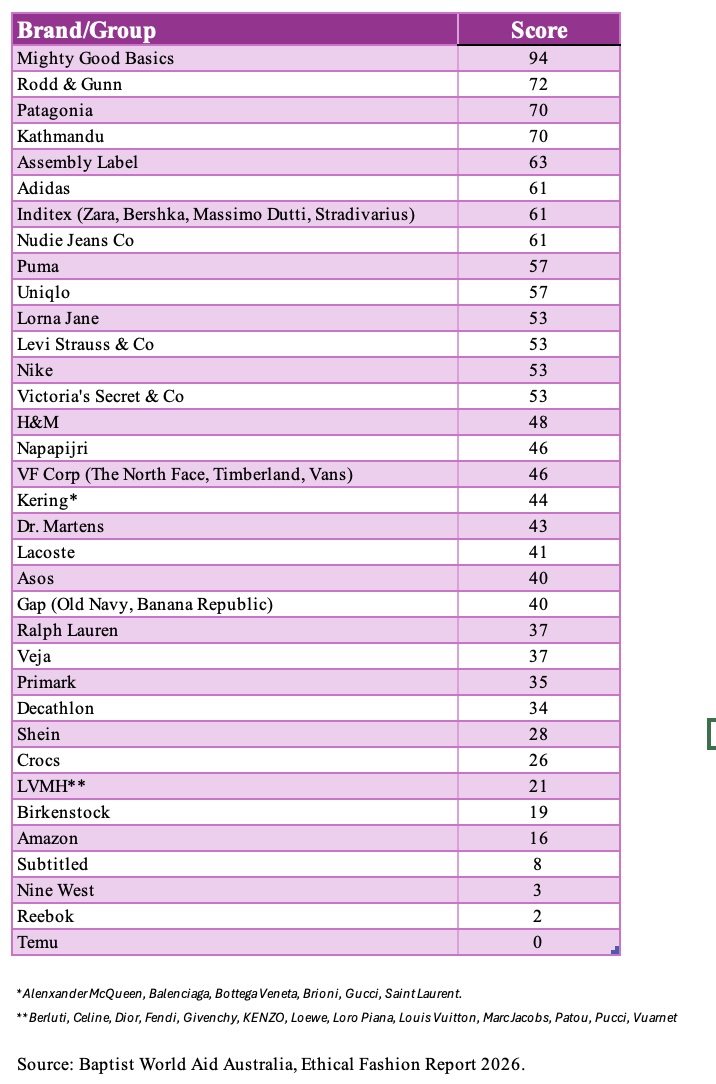
It is interesting to see Inditex at 61—ahead of H&M (48) and Primark (35), and roughly on par with Adidas and Nudie Jeans. This does not mean that Zara has become a model of sustainable fashion, nor that its production model is comparable to that of Nudie Jeans. It simply means that, based on the indicators examined, Inditex demonstrates a higher level of evidence and documented systems than other large corporate groups.
This is an important distinction: a relatively high score in supply chain management does not certify the overall sustainability of a business model. It does not tell us, for instance, whether the volume of production is compatible with a reduction in environmental impact, nor whether the pace at which new collections are released is sustainable.
Brands that build a reputation for sustainability are not automatically at the top
Some results warrant a closer look:
- Birkenstock: 19. A low score for a brand often associated with quality, durability, and natural materials.
- Veja: 37. An intermediate score—not comparable to the top results in this selection.
- Nudie Jeans: 61. A significantly higher score, offering an interesting point of comparison within the denim segment.
- Dr. Martens: 43. An intermediate score, despite the brand’s strong identity and the perception that its products are durable.
These cases help distinguish between two concepts often conflated in discussions about fashion: sustainability as perceived by the consumer, and a company’s ability to demonstrate how it manages risks throughout its supply chain. For instance, a long-lasting product may help reduce the frequency of purchases, but this does not automatically indicate whether the people who made it earned a living wage, or whether the company has visibility into the deeper tiers of its supply chain.
There is one piece of data that deserves particular attention: the comparison between luxury and fast fashion.
Despite vast differences in price and market positioning, an analysis cited by ABC News shows that luxury and premium brands received an average score of 38.63, compared to 37.91 for fast-fashion brands.
This does not mean that fast fashion has suddenly become sustainable, nor does it imply that both models have the same environmental impact. It simply means that, based on the specific criteria used in the report, the gap between the two segments is far less pronounced than one might imagine.
In fact, a high score indicates more structured management systems and more extensive documentation—not a clean bill of health regarding environmental or social impact.
Difficulties with transparency and supply chain management are not exclusive to companies that sell ultra-low-cost clothing; they can affect businesses of varying sizes, strategies, and market positions. For this reason, dividing the market strictly into “fast fashion” and “premium fashion” is insufficient for identifying where the core problems lie.
The paradox of sustainable fibers: improving is not enough if production continues to increase
Another interesting finding concerns the use of fibers considered more sustainable. The average share of sustainable fibers used by companies rose from 30% in 2024 to 38% in 2026—an improvement that, viewed in isolation, would seem positive. During the same period, however, global fiber production also increased, particularly regarding petroleum-based synthetic fibers.
According to Textile Exchange, worldwide fiber production grew by approximately 5% between 2024 and 2025.
The result is that an increase in the share of lower-impact materials does not necessarily translate into a reduction in the industry’s overall impact.
This brings us back to Temu and a fundamental aspect of its business model: the availability of a vast quantity of products at very low prices, coupled with a shopping experience that encourages a constant search for new deals.
A methodological clarification is necessary, however: the Ethical Fashion Report does not directly measure the volume of products uploaded to platforms, the gamification of applications, or the level of overproduction. These factors are not the core focus of its scoring system, yet they remain essential elements for a broader reflection on the sustainability of fashion.
Reflections
Temu’s result in the 2026 Ethical Fashion Report prompts a reflection that concerns the entire fashion industry.
For years, we have seen a proliferation of corporate sustainability statements, codes of ethics, commitments against forced labor, and promises to improve production conditions. But how much of this is actually verifiable?
Traceability is not merely a bureaucratic exercise. Knowing who makes our clothes, where the materials are sourced, and what conditions are guaranteed to workers is the essential prerequisite for identifying risks, taking action, and assuming responsibility for one’s business decisions. The case of Temu brings this issue into sharp focus, as its business model relies on a vast network of merchants and suppliers reaching consumers across the globe.
However, we should not stop at Temu. The results for other brands also demonstrate that a high price point, a prestigious image, or sustainability-focused messaging are not enough.
Sustainability must be verifiable throughout the entire supply chain.
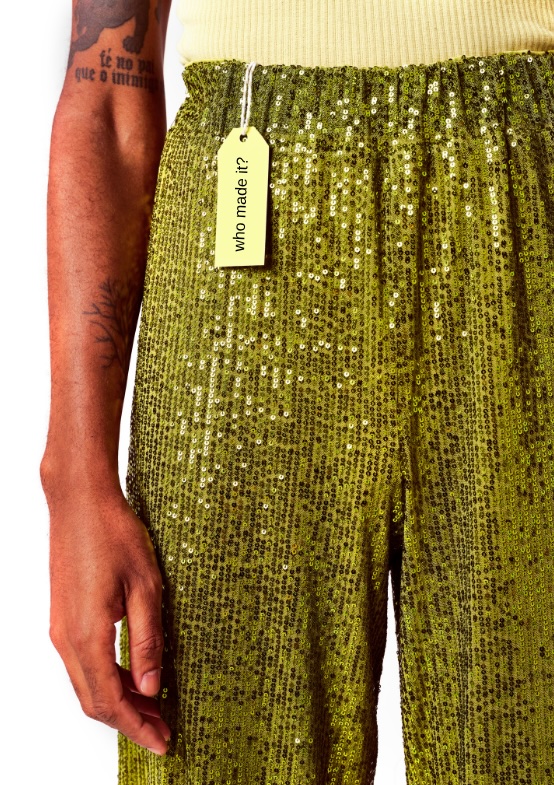
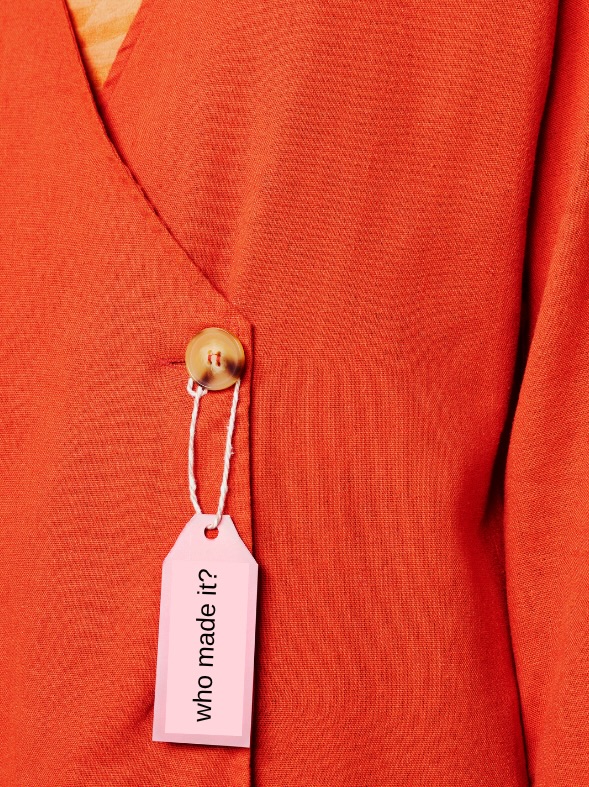
Before asking how much a garment costs, we should return to a fundamental question: who made it?
And if no one is willing—or able—to provide an answer, that in itself is a piece of information.

Potrebbero piacerti anche

Apps to organize your wardrobe and create your style more consciously

Vita da Dress ECOde – Dress ECOde’s life style
