

The man who wore Dior now wears Zara. Should we be happy?
 John Galliano returns to the atelier. But the collaboration with the Spanish giant Inditex raises questions that the press release hasn’t yet answered.
In January 2026, in Paris, a women’s dress designed by John Galliano for Dior sold at auction for € 637,500. A few weeks later, the same designer announced he would be working for Zara. Not for a six-piece capsule collection to be photographed on Instagram—for two years, with seasonal collections, drawing on the Spanish brand’s archive.
If you had a strange feeling reading these two sentences one after the other, that’s understandable. It doesn’t necessarily mean it’s wrong. It means it’s complicated. And complicated things deserve to be explored in depth.
In an era where sustainable and slow fashion are gaining ground, it’s legitimate to ask whether this choice represents a step forward or a contradiction to the sustainability values many consumers seek today.
Who is Galliano?
John Galliano is one of the greatest fashion technicians of the twentieth century. Born in Gibraltar, he trained in London at Central Saint Martins, and became creative director of Givenchy in 1995, then of Dior in 1996. For fifteen years, he transformed fashion shows into theatrical events—shows inspired by feudal Japan, Tsarist Russia, and the homeless of Paris—with clothes constructed on a sartorial architecture that many consider unsurpassed. His fashion shows were cinema, theater, and the anthropology of beauty. His bias-cut silk dresses reappear today on red carpets and at auctions.
In 2011, he was fired from Dior after a video showed him drunk in a Parisian bar uttering anti-Semitic remarks. It was a disastrous fall. Three years of silence followed, a detox, a year of study with a rabbi, and finally a public apology in the 2024 documentary High & Low. Professional rehabilitation came in 2014, when Renzo Rosso appointed him creative director of Maison Margiela. In ten years, Margiela’s sales grew by 24%. The Artisanal collection for winter 2024—presented under a Parisian bridge, featuring extreme corsetry and fabrics worked like sculptures—is considered one of the most powerful of the last twenty years.
In 2024, he left Margiela. For two years, silence. Then, on March 17, 2026, Zara.
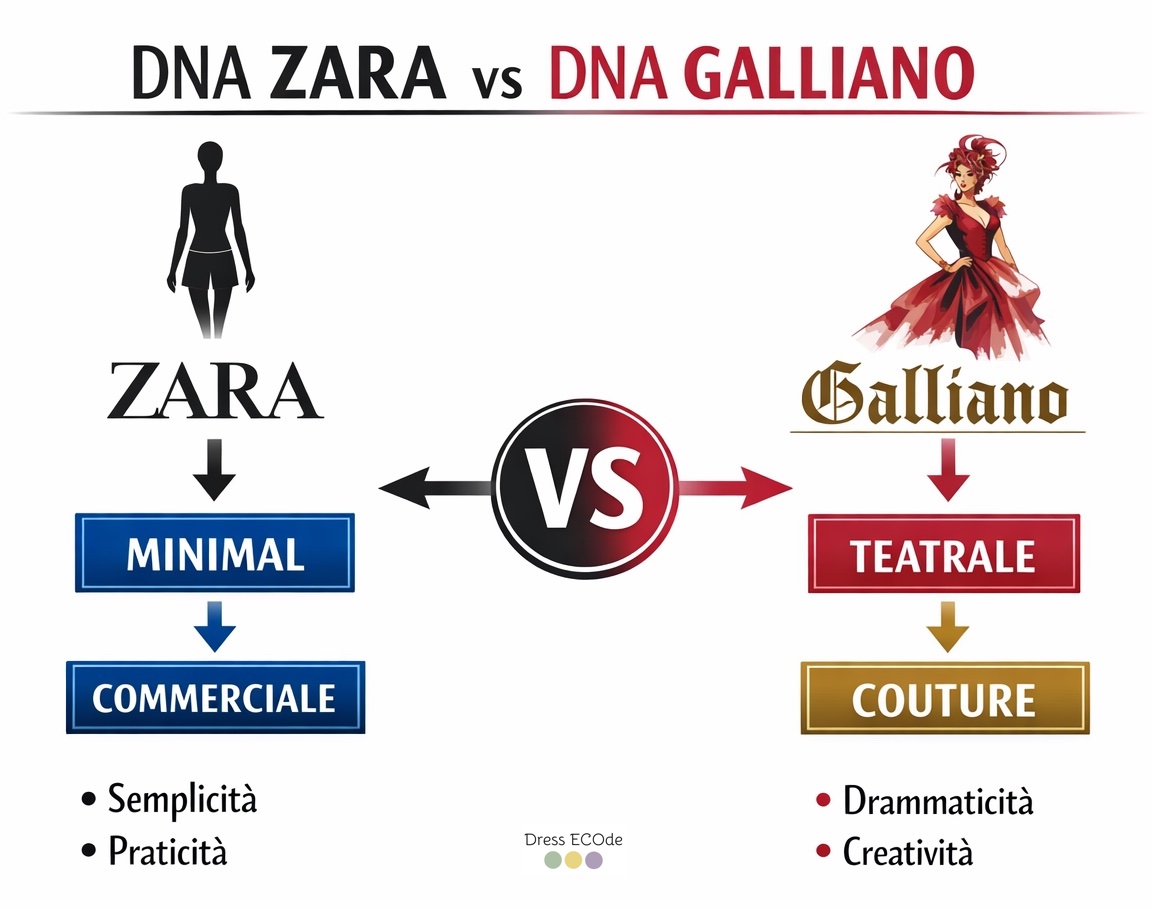
What exactly does the agreement provide — and what doesn’t it?
The joint statement states that Galliano will work directly with pieces from Zara’s past seasons, deconstructing and reconfiguring them into new expressions and seasonal creations. The process is called “re-authoring“—a word invented for the occasion, which doesn’t exist in the vocabulary of fashion or sustainability.
Here, it’s necessary to be precise. International press reports indicate that Galliano will create new toiles inspired by pieces from the Zara archives, with new shapes, fabrics, colors, and clothing bearing his distinctive signature (WWD). A toile, in tailoring parlance, is the canvas pattern that precedes the creation of the final garment—it’s the creative starting point. Translated: Galliano uses the Zara archive as a point of inspiration and formal starting point, not as physical material to be transformed piece by piece.
How significant this will be will depend on how much of the line actually comes from reworked stock versus newly manufactured products (Grazia International). We don’t know at this time, as the details of the collection are still unknown. Zara has announced that further information will be released later.
This distinction isn’t a technical detail. It’s the difference between an upcycling operation and a creative effort that uses the archive as inspiration—potentially producing entirely new garments. One reduces production volumes. The other doesn’t, or not necessarily.
Why Galliano says it’s sustainable
During Paris Fashion Week, Galliano told Vogue Business that the project is “a very positive thing to do right now, and truly creatively sustainable.”
The expression is interesting precisely because it contains an important qualification: creatively sustainable. It doesn’t say “environmentally sustainable.” It doesn’t say “low-impact.” It says: it’s sustainable as a creative approach—in the sense that it reuses, reinterprets, and doesn’t start from scratch.
It’s a fair distinction, if you read it that way. The problem is that in public discourse, and especially in marketing, “sustainable” has become a word used without specifying what it’s used for. And when Zara—one of the world’s largest fast-fashion producers—says that one of its lines is “sustainable,” the word carries with it all the weight of what isn’t said.
Inditex’s track record: what it says, what it does
Since 2022, Zara has been undergoing a strategic repositioning process to break away from fast fashion. Galliano is not an isolated case—he is the latest in a string of high-profile designers who have collaborated with Zara, including Narciso Rodriguez, Stefano Pilati, Kate Moss, and Steven Meisel.
Inditex is a company that claims not to ignore sustainability. In its 2025 report, it states that 88% of the fibers used are alternatives with a lower environmental impact, with 47% recycled fibers. Between 2020 and 2025, it reduced unit water consumption in the supply chain by 25%.
These numbers exist. But they must be read within a broader context. A Thomson Reuters Foundation investigation has documented how Inditex’s use of air freight to fuel the fast fashion market is excessive and growing—a practice that contributes to the climate crisis and increases pressure on workers, forced to work unsustainable hours for low wages, exactly the opposite of what is disclosed in sustainability reports.
And there’s a structural question that no press release answers: does the Galliano line add to Zara’s existing production, or does it partially replace it? If the answer is “adds,” the company’s net environmental impact increases, not decreases—regardless of the creative sophistication of the project.
Why this news is also a symptom
Beyond Galliano and Zara, this story tells about something larger about the fashion industry right now.
With Dior and Chanel charging €5,000 for a jacket, €4,000 for a bag, and couture reaching €135,000 for a dress, the trend is moving in the opposite direction (The Hollywood Reporter). Galliano isn’t alone—Francesco Risso, former creative director of Marni, has taken the helm of Gu, a brand of the Fast Retailing group; Clare Waight Keller, former creative director of Givenchy, is now creative director of Uniqlo; and Zac Posen has taken over as creative director of Gap (Il Sole 24 Ore).
This phenomenon has at least two interpretations. The first, optimistic: high-end creativity is finally becoming accessible to a wider audience, democratizing an aesthetic language that had remained locked away within the fashion houses for decades. The second, more critical point: big names lend their cultural reputation to brands that need it to compete with Shein and Temu on a terrain—credibility—where low prices are no longer enough.
Ultrafast players like Shein and Temu can always be cheaper and faster. They can’t easily compete on cultural authority. Partnering with a designer whose archive breaks auction records is a way to buy credibility, not just clicks (Grazia International).
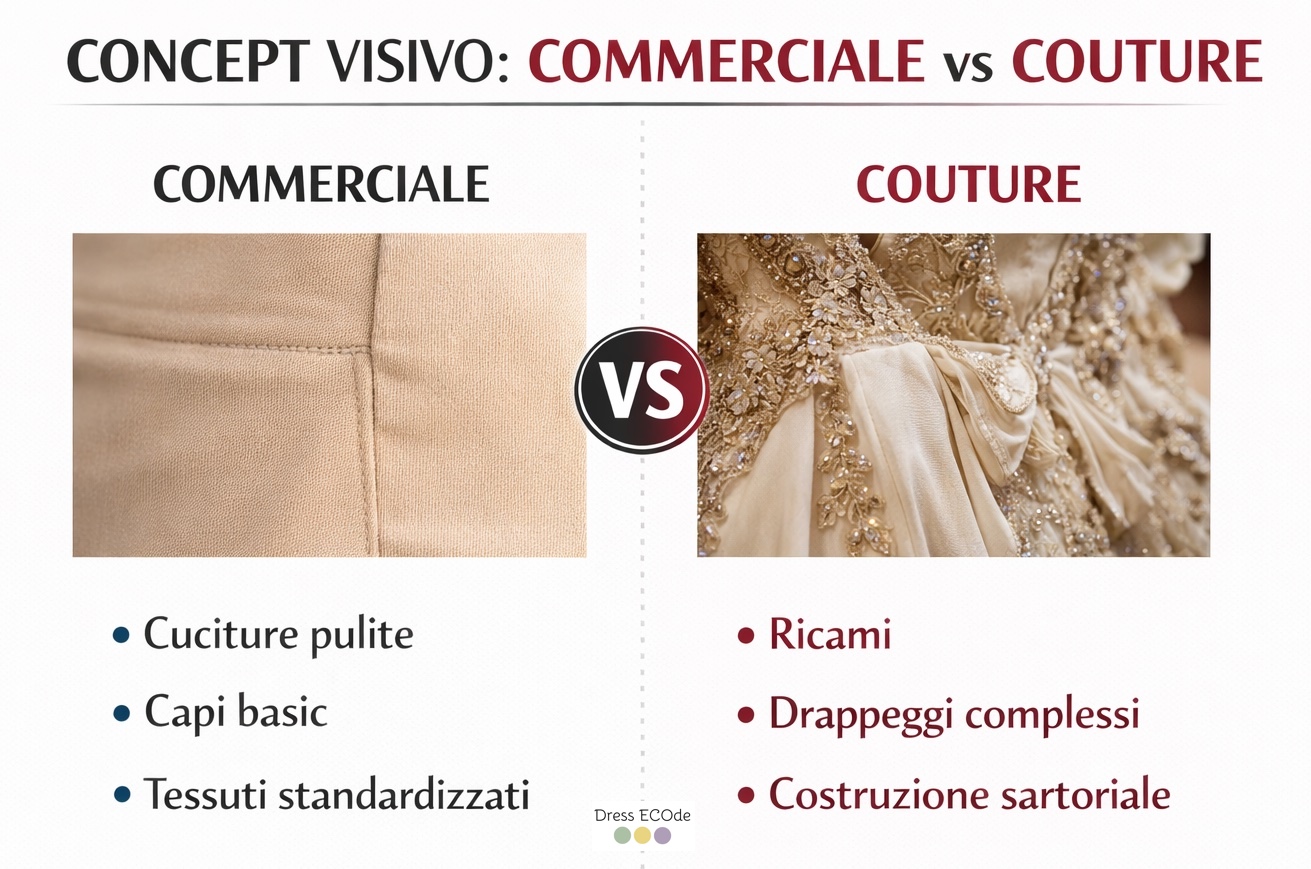
A phenomenon that has a name
What’s happening with Galliano and Zara already has a name: luxurywashing. It’s not greenwashing in the classic sense of the term—it’s not about declaring a garment “eco-friendly” when it isn’t. It’s something more subtle and, therefore, more difficult to recognize. It consists of associating a large-scale retail brand with the symbolic, aesthetic, and reputational capital of a designer name—with the effect of making the entire company appear more sophisticated, more responsible, more trustworthy. The single project becomes a patina that, in the collective imagination, extends to the rest of the production.
It’s not a new mechanism. It’s exactly what greenwashing research has been describing for years as the “halo effect”: the main risk lies not in the materials of the capsule collection itself, but in the halo it confers on the brand. By aligning itself with an icon of creativity or sustainability, a company risks obscuring the environmental impact of the millions of other garments it produces every year.
There’s a deeper question that all these collaborations—Galliano with Zara, McCartney with H&M, Posen with Gap, Risso with Gu—highlight without answering. It’s this: can large mass-market retailers truly change from within through individual creative projects? Or are these projects functionally compatible with a production model that—in its basic structure—remains founded on speed, volume, and constant replacement?
It’s not about accusing Zara of lying. It’s about recognizing a systemic mechanism: when a company that produces at industrial volumes introduces a niche project with a focus on reuse, the communicative impact is disproportionate to the actual effect. The project becomes the company’s narrative about itself—and this narrative tends to take up much more space than the project itself.
There’s a paradox at the heart of this story that’s worth naming precisely. Sustainable fashion—the real kind, the kind Dress ECOde has been championing for years—is based on a principle opposed to the logic of seasonal drops: the idea that you buy less, choose better, and keep items longer. The Galliano-Zara collaboration, however, was born within a structure that distributes to thousands of stores worldwide and has built its identity on the idea that there’s always something new to buy. Even if Galliano truly brought a philosophy of transformation to Zara, that philosophy would find itself operating within a system that, by definition, moves in the opposite direction.
This isn’t an accusation. It’s a structural contradiction. And structural contradictions aren’t solved with capsule collections—they’re solved with business models.
What we don’t know yet — and why that’s the point
The first collection will be released in September 2026. Only then will we be able to answer the questions that really matter. How many pieces will be produced? At what price will they be sold? Are the garments physically derived from existing stock or are they produced from scratch from an archive? Will the Galliano line reduce Zara’s overall production or complement it? Will anything change in the working conditions of the supply chains?
None of these elements are in the press release. And this absence is as informative as the press release itself.
The word “re-authoring” is beautiful. It’s evocative. But it’s not a certification. It’s not a supply chain audit. It’s not environmental impact data. It’s just a word. And in sustainable fashion, fine words come cheap.
Three concrete things you can do
First. Wait until September. Not because the collection will necessarily be wrong—but because without seeing the garments, labels, prices, and supply chain communications, you don’t yet have the tools to judge.
Second. Ask yourself questions. If the collection is released in Zara stores near you, look at the labels carefully: what materials are listed? Is there a QR code that links to supply chain information? Is there an indication that the garment comes from existing stock? Transparency is measured in the details, not in campaigns.
Third. Use this news as an opportunity to ask yourself something bigger: when I buy a garment because it carries a big name, am I buying something that truly reduces the impact of fashion—or am I buying the feeling of doing so?
Should we be happy?
We probably don’t know yet. And the honest answer is precisely this: let’s wait for the facts.
The challenge is finding a balance between accessibility and environmental responsibility, but the press release hasn’t yet clarified how this collaboration intends to address these crucial issues. So the question remains: should we be happy to see an iconic designer embrace a brand so tied to rapid production? Perhaps this partnership could be an opportunity to bring innovation and awareness to fast fashion, but only time will tell if this will actually be the case.
Galliano is one of the greatest technical talents in the history of fashion. Working from the archive rather than from a blank sheet of paper is, in principle, a more sober approach than compulsive creation. And bringing couture reasoning—slow, constructive, attentive to form—into a global production system could, in theory, influence its culture from within.
But sustainable fashion has already seen too many “in theory” ideas that have never been translated into practice. We’ve already seen too many big names lent to operations that have essentially changed nothing in terms of volumes, the supply chain, or working conditions. Enthusiasm is legitimate. Reserve is necessary. And curiosity—the true kind, which awaits the facts before judging—is the only tool that protects us from both easy cynicism and equally easy credulity.
We’ll see in September. What we can do now is keep our eyes open. Because when a genius encounters a global production machine, he doesn’t change it—unless the machine truly wants to change.
In the meantime, questions remain open. And keeping them open isn’t a flaw: it’s the only form of honesty possible at this time.
Sources: WWD, Business of Fashion, Marie Claire Australia, Grazia International, ANSA, Il Sole 24 Ore, Inditex Sustainability Report 2025, Thomson Reuters Foundation/Context, Euronews, Hollywood Reporter, Hypebeast.

Potrebbero piacerti anche

What companies respond to a sector study in which it emerges that they do not provide evidence of living wages paid to those who work for them

Eco, green, carbon neutral: the words banned by the EU to stop greenwashing
